

Choosing a bookshelf for your child may seem simple, but the design you pick can actually influence how often your child reads, how independent they become, and how organised your home stays.
The two most common options parents consider are the traditional bookshelf and the rotating bookshelf. Each has its own advantages, but they work very differently in a child’s environment.
Let’s take a closer look to help you decide which is better for your family.
How Books Are Displayed
Traditional Bookshelf
Traditional bookshelves store books in a row, showing only the spine.
While this works well for adults, younger children often cannot recognise books by their spine alone. This means they may rely on parents to pick books for them.
Rotating Bookshelf
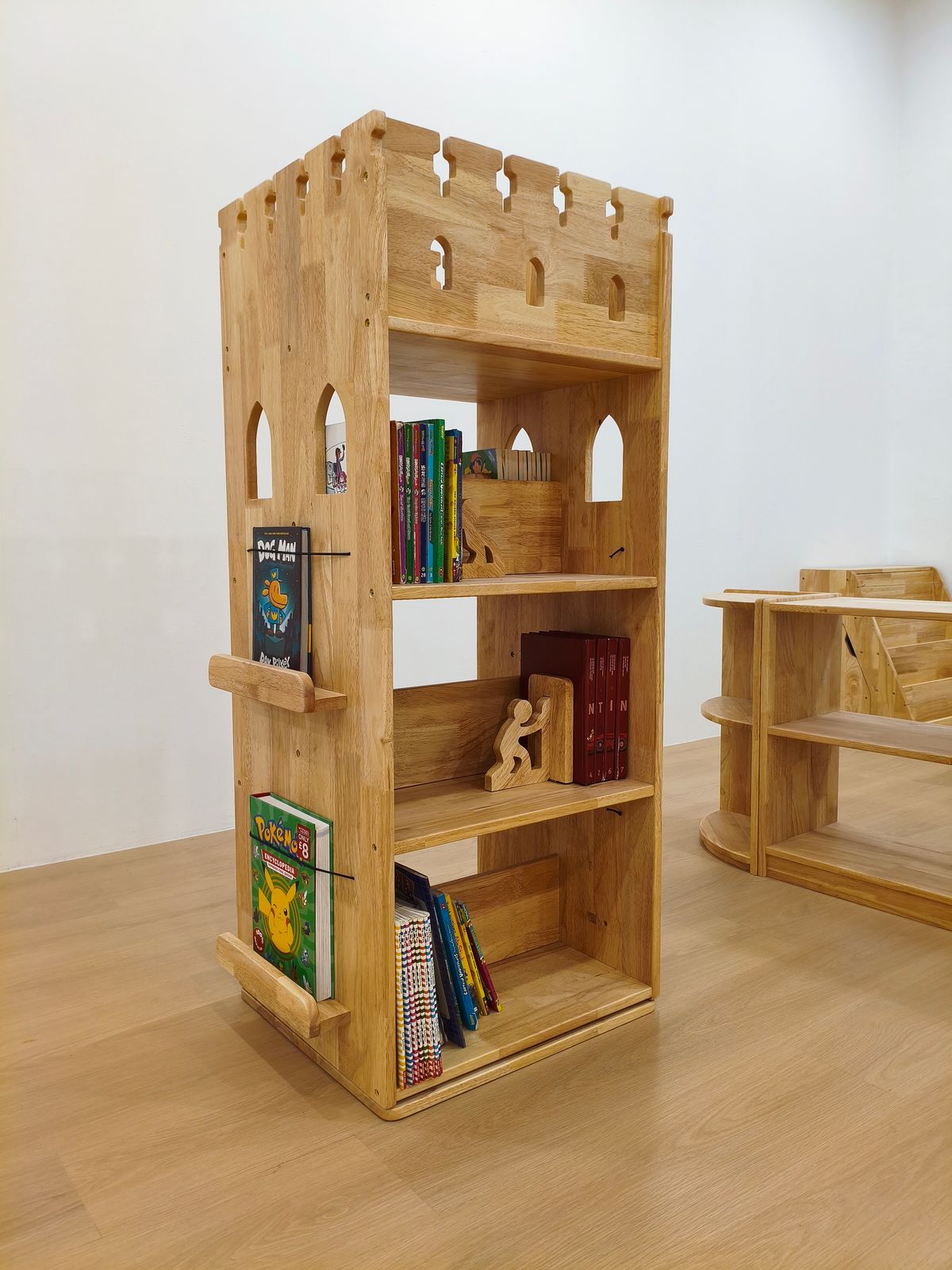
A rotating bookshelf displays books in a more visible, front-facing way. Children can easily see covers, which naturally attract their attention.
This encourages:
- Independent book selection
- More frequent reading
- Stronger interest in stories
When children can see what they read, they are more likely to engage with it.
Accessibility for Children
Traditional Bookshelf
Some traditional bookshelves are too tall or deep for toddlers. Books placed at the back are often hard to reach, which reduces independence.
Rotating Bookshelf
A rotating bookshelf is designed with children in mind. Books are placed within easy reach from all sides, allowing children to:
Choose books on their own
- Return books easily
- Develop responsibility
- This supports Montessori-style learning where independence is encouraged in daily routines.
Space Efficiency
Traditional Bookshelf
Traditional bookshelves usually require a long wall space. As the book collection grows, more horizontal space is needed.
Rotating Bookshelf
A rotating bookshelf uses vertical space instead of wall space. It stores many books while occupying a small footprint.
This makes it ideal for:
- Small bedrooms
- Apartments and condos
- Play corners
It is a smart solution for families who want storage without clutter.
Organisation and Tidiness
Traditional Bookshelf
Books can become messy quickly, especially when children pull out multiple books at once. Without clear organisation, it may look cluttered.
Rotating Bookshelf
Because books are arranged in sections around the structure, it is easier to organise by category (storybooks, learning books, bedtime stories, etc.).
It also encourages children to return books properly because each side feels like a “special section.”
Visual Appeal in a Child’s Room
Traditional Bookshelf
Simple, functional, but often plain. It blends into the wall but may not stand out as a reading feature.
Rotating Bookshelf
A rotating bookshelf becomes a feature piece in the room. Its 360° design makes it visually interesting and interactive for children.
It naturally becomes part of the play and reading environment.
Which One Is Better?
There is no one-size-fits-all answer. It depends on your child’s age, your space, and your goals.
If you want simple storage for a large collection, a traditional bookshelf works well.
If you want to encourage independent reading and save space, a rotating bookshelf is often the better choice.
Many parents actually use both:
Traditional bookshelf for older books and storage
Rotating bookshelf for daily reading access
How Unicraft & Decor Designs Help
At Unicraft & Decor, our wooden rotating bookshelves are designed to combine:
- Child-friendly height
- Solid rubberwood durability
- Front-facing book display
- Compact space-saving structure
Our Kurukuma Rotating Bookshelf is ideal for smaller spaces and first-time book storage setups.
Our Tenshu Rotating Bookshelf offers larger capacity and display sections for growing book collections.
Both are designed to make reading more visible, accessible, and enjoyable for children.
Final Thoughts
A bookshelf is more than furniture. It shapes how children interact with books every day.
Traditional bookshelves offer structure and storage, while rotating bookshelves encourage interaction and independence.
If your goal is to build a reading habit early, the way books are displayed matters just as much as the books themselves.


